Tuesday, 31 January 2012

THE DESCENDANTS


“Paradise? Paradise can go fuck itself.”

This line pretty much sums up the entire philosophy of Matt King (George Clooney), a middle-aged man in crisis. His wife is in a coma after hitting her head in a boating accident, his 10-year-old daughter Scottie (Amara Miller) is acting out, and 17-year-old daughter Alex (Shailene Woodley) is all too aware how absent her father has been over the course of their lives. Then, just to make the whole matter worse, Alex reveals to her father that his wife was having an affair before the accident.

The Descendants is the long awaited return from Alexander Payne, director of Oscar Winning Sideways (for best adapted screenplay, which he also co-wrote), and deals with themes of the family, uncertainty, and reconnection in the same way as many Indie films of the same ilk. Infused with a degree of honesty that births humour from a bad situation and everyday occurrences, it rings much like Win Win or Little Miss Sunshine in its portrayal of a patriarch struggling with the world he has built for himself.


It’s this honesty that really makes the film shine and coupled with the delicate intimacy that Payne directs the film with, it feels like you’re taking the journey with them. Every character turn and plot twist reveals something new and draws in your sympathies - even with Alex’s stereotypical douchebag surfer friend, Sid, who tags along for her moral support. This is screenwriting at its best and I would be happy if it picks up Payne’s second Oscar for best adapted screenplay (but the prize will probably go to Moneyball, which admittedly, I haven’t seen so I shouldn’t really be judging).

However, it’s not just great writing that make the characters come to life. The performances by the entire cast are great - especially from the younger members. Scottie has a great naivety as she struggles to understand why the people around her are acting so weird, Alex is brash and outspoken whilst hiding her emotions to protect her little sister and Sid turns out to be much more than the 2 dimensional ‘surfer dude’ we’re introduced to. And of course there is Clooney’s master class in restrained acting - bettered this (Oscar) year only by Gary Oldman in Tinker Tailor Soldier Spy - but whether you believe Clooney as a struggling family man will affect whether you believe entirely in his character. But what makes the performances stand out is that they feel completely real.


The realism of the film turns it into a piece of work that doesn’t romanticise everything. There isn’t a sweeping orchestral score dictating our emotions (the music used is wonderful, but I’ll let you see it and find out for yourself), there aren’t explosions of emotions to show how distraught the characters are, the cinematography is beautiful without being like a postcard tour of Hawaii and its neighbouring islands and the comedy all comes from very real dialogue instead of big set piece jokes and slapstick. Yet it isn’t an entirely realistic film in that it depicts real life as we live it, the realism instead is embedded deeper in the subtext and comes about as something that all films seek to explore - truth.

A classic film reveals or explores a particular truth about the human condition (even blockbusters such as Jurassic Park - man’s futile desire to play God/control life), which is why they become timeless. And whether The Descendants becomes a commercial smash hit or not, it will stand the test of time because its honest and real portrayal of a father under pressure explores something we should all think about - what will our descendant generations inherit, both physically and morally, from us?

Wednesday, 18 January 2012

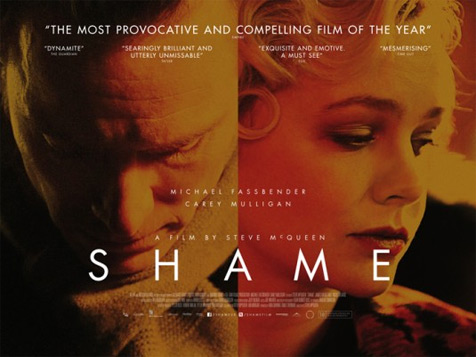
SHAME


When I first watched ‘Hunger’ - the debut feature film from British artist Steve McQueen - it was hard not to be taken aback by such an intimate portrait of human extremes and where it did have its flaws (creeping into artsy pretentiousness), it was a very strong stepping stone to bridge the gap from art to feature film making. His sophomore feature, ‘Shame’ is a much more refined piece of film craft that really shows McQueen is definitely a director to watch out for in the future.

Brandon (Michael Fassbender) is a model citizen of Manhattan. He’s top dog in his job, he’s charming, well dressed and lives in a comfortable, modern flat high up in the city. However, he’s also a sex addict - an addiction he works around in his day-to-day life with calm calculation. But when his younger sister, Sissy (Carey Mulligan), comes for an unexpected (and indefinite) visit, his routine is shattered and he is forced to deal with his addiction.


But to say that this is a film about sex addiction would make it sound like a film that tried to deal with the issues surrounding it: causes, problems and the effect it has on Brandon and those around him. This couldn’t be further from the truth. The causes are only hinted at, the problems it brings aren’t black and white and the effects are not what we would imagine. Not least because Sissy is just as damaged as Brandon. So it’s much more like a portrait of people dealing with their emotional damages and it just so happens that the protagonist we find ourselves with manifests these damages as a sex addiction.

It’s this emotional quality of the film that is the driving force of the story, rather than actual plot. Taking place over the course of a few days, we see slices of Brandon’s life and routine and how once Sissy appears, the utter contrast between the two characters completely disrupts it. They are both complete train wrecks of people who have both developed their own ways of dealing with life. Where Brandon is sophisticated and introverted, Sissy is impulsive and extroverted. But both of them share a traumatic past that is never revealed and all we know is that despite being total opposites, they both share a tragic loneliness. This is most clear during a sequence in which Sissy sings an original, haunting rendition of “New York, New York” at a stylish Manhattan bar. The shots are close and editing is minimal and the emotion is ramped up by the magnificent performances of both actors.


Both Fassbender and Mulligan give the performances of their careers. The lingering shots of Brandon doing very little other than thinking are utterly compelling to watch and to see Mulligan playing the total opposite of her usual quiet, mousy characters is incredibly refreshing. These performances are emphasised by McQueen’s use of the long take, where emotional beats of the script change and the performances change with them. The performances also work in harmony with all visual aspects of the film. Both characters are seen in reflections, shot through glass or we see the backs of them. McQueen places the audience in the position of a voyeur, keeping us visually distant from the characters as they distance themselves from everyone around them in their own ways. It all comes together to produce a film more about crushing isolation than sex addiction.

What really struck me about the film was the audience reaction to when the unflinching and raw sex scenes appeared. There was a lot of awkward laughter, which was intriguing to say the least - the presentation of sex as essentially animalistic seemed to make the audience squirm. Believe me when I say the sex scenes aren’t sexy, not in the traditional Hollywood sense anyway. There isn’t any sweeping emotional music or rich colours with glamorous lighting - it’s just pure fucking.

But the question of the laughter is an intriguing one. Maybe by placing us in a position of voyeurism, McQueen is placing the audience in Brandon’s position when a work colleague discovers his work computer is full of porn - that embarrassment of being caught? Or maybe laughing off the sex scenes is an emotional barrier for the realism involved - we don’t want to admit that we have sex in such an animalistic and unromantic fashion?

Sounds like an essay topic, I’m digressing a little.

But despite the frank and graphic sex scenes, the real emotional plight of the film comes from the parts that made the audience laugh for another reason: seeing two characters having genuinely comic and emotional interactions - little moments showing that both Brandon and Sissy have the potential to engage in an emotional relationship with someone, but their debilitating personalities won’t allow them. That’s what makes this film so ultimately tragic, yet utterly compelling. It’s a weighty film to watch, but if you see any film at the cinema this awards season, make sure it’s this one as it’s worth every single penny you’ll spend on it... 


...just don’t bring your parents or first dates with you.

Sunday, 15 January 2012

THE IRON LADY


OK, so I was born in 1988, well into the latter years of Thatcher’s reign and until she left Number 10, I was more concerned with my toys and food than the state of the country. So I’ve never really known much about her politics or what she had done, which actually made walking into this film quite refreshing - I was free from any particular bias towards the woman who is the main subject of the film. However, that was where the refreshment ended as we were propelled into Phyllidia Lloyd’s confused and sentimental biopic about one of the most controversial politicians in this country’s history.

The main base of the story revolves around Thatcher in the present day, going about her day-to-day life. She is a grieving woman growing old and senile, far from the picture that public memory has. From having conversations with her dead husband, she begins to remember times from her formative younger years as a grocer’s daughter to her years as prime minister. We jump back and forth through the narrative as the script (written by Abi Morgan) attempts to contrast the past and the present to reveal Thatcher’s human side, but it only really serves to turn her life into a series of episodes that attempt to define what she stood for.


The biggest problem with the narrative is that as it jumps around, it really doesn’t know what kind of film it wants to be. It’s trying to be an emotional portrait of a woman who no longer has the power she had, it’s a biopic of a divisive public figure, it’s a film about a grieving wife. It deals with themes of power, madness, death, loss, politics, sexism in politics, belief in what is right, belief in one’s self, grief, family, the cost of power and probably a few more that I probably don’t remember. The choice of events to go back to are too varied, pretty much warranting their own feature length film and thus leads the film not only to be rather confused, but it also turns these complex events into ones that are oversimplified and lack any emotional or narrative weight.

I suppose there should be some mention of Meryl Streep’s “please please please give me the Oscar” performance. There, that was it. It doesn’t matter how good her performance is - and there were moments when she was fantastic (but I’ve seen better) - it can’t carry a film that’s as weak as this.


It is nothing but pure Oscar bait, trying its best to please everyone but ultimately, it pleases no one. For the emerging middle class of the 1980’s, who might praise Thatcher for what she did and how she helped the country, the film is a soppy love letter that presents her in a way that totally differs from how they remember her. Then for the working class, who endured and rioted against many of her policies (if they put their political bias aside and actually watch it), its reluctance to engage with the political issues and presentation of them simply as ‘events that happened to her’ could (and probably should) be considered a massive insult.

So as the final frames roll, and Maggie ambles away to carry on with her life, we are left with an empty, blue (the amount of blue in this film is practically insulting, YES WE KNOW SHE WAS A CONSERVATIVE) kitchen and hallway, the camera lingers as the credits begin to roll and the image fades to black. That pretty much sums up the entire film - empty and blue and as confused as the aged Maggie appears to be.


Sunday, 8 January 2012

THE ARTIST: REVIEW


Every now and again, a film will come along that dispels the whole “they don’t make them like they used to” belief, but never before have I seen a film that actively enforces it. I mean, many films enforce the belief by being so utterly terrible (just look at last year’s blockbusters), but to see a film that’s deliberately provoking that vintage nostalgia of cinema at its most basic form of storytelling is actually quite refreshing.

Hollywood, 1927. George Valentin is a major star in silent films and at the peak of his career. Outside the premiere of his latest hit, a young aspiring actress - Peppy Miller - waits patiently for an autograph. A chance encounter between the two in the chaotic crowd begins the narrative, charting the rise of Peppy and the fall of George as sound is introduced to cinema and the great depression begins.

This is visual storytelling at its most rich, yet basic. Complex emotions and plot developments are reduced to nothing more than a few simple gestures, dialogue cards (used very sparingly) and visual design. What the director - Michel Hazanavicius - has done here, is create something that appears to be very simple, but in actuality is incredibly complex. The lack of speech has lead every other aspect of the production to do its absolute utmost to convey the emotions, plot points and ideas. Everything here works in harmony to stir emotions in an audience the way that all films should.


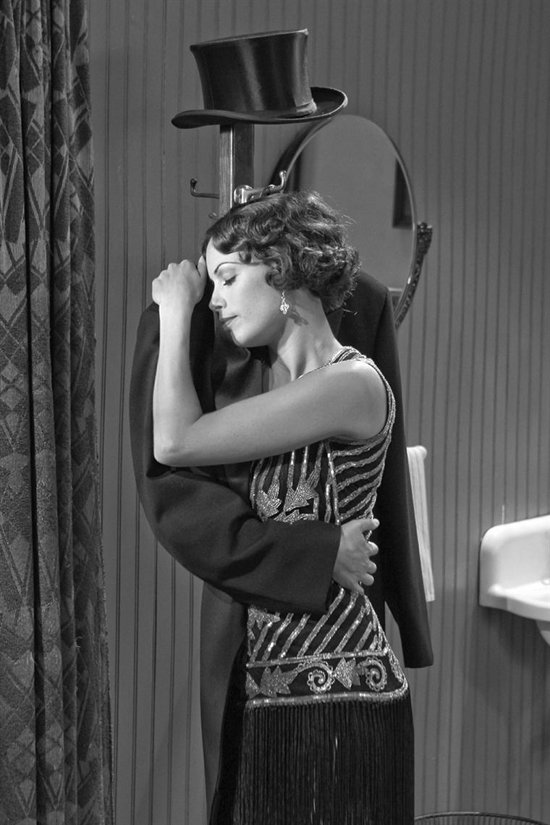
Look at this picture as an example. Here, Peppy Miller has snuck into George Valentin’s dressing room to leave a thank you note for an earlier deed he had done to help her. From the initial spark when they first met, we had an inkling of their feelings towards each other, but here we get inside Peppy’s head and what she’s thinking. We see her fantasy and this in turn reveals her feelings for George in an incredibly original way. It’s a brilliant play on vision, being slightly comic, but incredibly intimate. These kind of images perpetuate the film and are what gives it the incredible beauty that it has.

I can’t really talk about this film without mentioning the performance of Jean Dujardin as George, which is one of the most prolific and wonderful performances of the year. Offering charm and charisma, but only as a mask to hide his cynical bitterness and pride. This is a character that is so complex that Hazanavicius’ handling of him is simply masterful. The journey we follow him on is an emotional one, and you really feel for him when he reaches a crisis point, but also laugh when he’s being funny. It’s rare that a character can take you on such highs and lows alone in this way. With a fantastic supporting cast, not one performance takes a bad turn, with John Goodman playing the traditional fat cat in a suit producer, Bénérice Bejo as the young Peppy Miller and James Cromwell as George’s loyal and faithful driver, Clifton. They all have an extraordinary chemistry, which allows you to forgive the incredible typecasting that has taken place.


However, despite the superb direction, incredible cinematography and powerhouse performances, it’s own medium as a silent film is the biggest downfall this film has. Not because it was a bad choice, or because it made it a bad film. It’s because no matter how much publicity or critical praise it gets, no matter how many stars you slap on the posters (believe me, there are a lot), it will not take a lot of money because of the modern mainstream audience’s aversion to anything that doesn’t involve big guns, explosions or fart jokes.

But for me, what is most interesting about The Artist is how relevant it still is today. The main narrative and the sub-plots are all completely universal, and it offers a critique of the industry that it tells the story about. The pride of the old with their reaction to new technology, trying to hold on to their old ways is very allegorical to what is happening today with the rise of digital technology and the industry’s struggle with Internet piracy. But past the struggle between old and new, it ultimately is about how the new can embrace the old and carry it through so that it will last. You can apply it to many industries, but specifically for filmmakers, the new generation my be embracing digital technology for its affordability, but there will always be the utmost respect for celluloid and if the suits let them, they will preserve and look after film as a means of production for decades to come. 


Wednesday, 4 January 2012

WAR HORSE: REVIEW


When I heard that Steven Spielberg was embarking on a new project, I was sceptical. Having nothing particularly notable to his name since Munich (somewhat underrated), it seemed that he had lost his spark. I need only mention the latest Indiana Jones to send shivers down the spines of anyone that has the slightest hint of good taste in anything.


However, upon hearing he was going to be adapting War Horse - being a colossal success on stage (which in turn was adapted from a children’s novel) - for the big screen, a glimmer of hope appeared. This was Spielberg returning to his classic territory – a story of an unbreakable bond, set in the First World War, between a boy and his horse in a sort of Black Beauty meets Saving Private Ryan affair. Incredibly schmaltzy, but he’s proven he can deal with these themes in an incredibly engaging way (Saving Private Ryan is one of the most shamelessly patriotic, overly romantic, and brilliantly constructed films to come out of Hollywood).


Joey is a horse, bought by a drunken farmer at a livestock auction in Devon, for more money than the poor man can afford. The farmer’s son forms an instant bond with the horse, and the horse pulls its weight around the farm against the odds. World War 1 breaks out and Joey is sold to the army, upon which he embarks on a journey encountering many people and many hardships until eventually, in the depths of the trenches, he is reunited with his original owner – cue the Kleenex.


Drawing from both the original source text, with its story told from the horse’s perspective, and the stage show, with its intensity and incredible visual style, the film becomes confused as to what it wants to do. The film is from the horse’s point of view, focusing on the beast’s power to bring out the best in people. But it also attempts to be violent and intense in a family friendly way. What this leads to is brief encounters with chief characters with which we have no time to empathise with and intense sequences lacking a visceral punch to make it effective.


I can’t say this is true for the entirety of the film though, there are segments where you do see Spielberg’s mastery of this brand of film shine out (2 have stuck in my mind since seeing it), but they are too few and far between to give the film the emotional clout that such a story deserves. The characters are so thinly spread that they become pantomime like tropes in order to make the audience remember who they are and the focus on the boy’s bond to his horse is virtually nonexistent so by the end that you feel the entire first act was a waste of time. There was also a completely schizophrenic cinematic style in the opening that I’m convinced was done entirely to combat the shitty British weather that confused the film as to whether it was trying to be realistic or pure fantasy.


But these are not the weakest points of this film. The biggest shortcoming is the actual horse itself. Where the things they manage to get the horse to do for the film are something quite spectacular, for the entire story to be focussed from his point of view means that we have to find some way to connect with him in the supposed way the characters do. This is pretty hard to do with a live action horse, and where the film could have benefited more from being animated. Allow me to explain; films such as Dumbo or Wall-E – both classic family films – feature protagonists that do not speak. Yet they both manage to carry the entire plot for the film’s duration. Why? Because the animators can control their facial expressions, they can emote. A live action animal cannot convey emotions on cue. If they could, I’m sure we’d be replacing many actors with highly trained chimps (and in the case of Orlando Bloom, I’m surprised they haven’t already). So for a live action film to be from the point of view of an animal just cannot work, as we cannot understand its feelings and thus the film keeps its audience at a considerable distance.


It’s a shame, because as a film, this had great potential. There’s great source material (the stage show blows the film completely out of the water), and you can see the technical prowess of Spielberg at work throughout - from the classic John Williams score that swoops and blossoms in all the right places to the grandiose camerawork depicting a luscious British countryside – but it all falls flat because at the end of it all, it’s just a series of vignettes telling us how incredible the horse is and it’s showing us how emotional we should be without actually invoking any emotions in us by using generic, romanticism in every sequence. Ultimately, it’s just patronising.

Sunday, 25 September 2011

DRIVE


Cars and violence, what's not to love?

Holy shit! I have a review out that’s not 3 weeks after the release date! And now that we’re over that, let’s talk about Drive.

You’d think a film called Drive - which focuses on a stunt driver who moonlights as a getaway driver, on the run from the mob after a heist gone wrong and out for revenge on those responsible - would be full of action, car chases and a pounding soundtrack that sets out to abuse your senses in the same way a drunk hillbilly beats up his wife. But you couldn’t be further from the truth, and thank fuck for that because it shows that you can actually make a standard genre movie compelling, visually complex, and absolutely beautiful without resorting to the plot hole mind fuck stories like Inception.

Yup...I can predict that you needed a plane so I bought an airline for you...
Drive is a simple film, where less is more, and subtlety is king. It’s a very standard Noir Thriller with a simple story, but Nicolas Winding Refn (most known for Bronson) picked up the Best Director award at Cannes this year for this film, and you don’t get that just for making your standard run of the mill genre film otherwise, heaven forbid, Michael Bay would win the Palme D’Or. And if that happened, I would lose my faith in humanity and smear my rancid shit on the walls of a children’s hospital or something.
What Refn has done is to make a film that is rich and textured visually, audibly and most importantly, thematically. It all seems very 80’s but it is clearly set in the present day. There’s all the tacky neon you could want and even the soundtrack beats that 80’s synth pop we all know and love. Even down to the detail of the pink italicised paintbrush type in the credits. It’s got the aesthetic as if they had actually filmed Grand Theft Auto: Vice City without the 80’s campness. But through all of the visual and audible stylisation, it is the themes and character that stand out and the simplicity of the story has allowed Refn to focus thoroughly on it and create this award winning vision.
That’s not to say this film is without it’s flaws though, there are a couple of gaping plot holes and sometimes Carey Mulligan’s Irene seems a little too helpless. There are clichés and the beginning all seems a bit too saccharine sweet for the kind of Jeckyll and Hyde theme that resonates throughout the film. But these flaws are completely overwhelmed by the intricacy with which this film has been crafted.
However, there is a rather colossal flaw, which I don’t really seem to understand, and that’s the UK age certificate. The film’s been given an 18 rating, which is pretty much a commercial death sentence in this country. With the attendance for 18 rated films at an all time low, all the studios are out to trivialise their violent content into cartoonish drivel so that they get certified 15. This is partly to blame for the desensitisation of our youth, but also means films like Drive won’t get to a larger audience in the cinema because the violence here is too ‘real’. But in the US, this film has a RESTRICTED rating. Which means anyone under 17 can go as long as they are with an adult over 18. This rating is MORE SENSIBLE because not only do the studios get the sales of the tickets, the parents can decide if their 15 or 16 year old kids are fit to see the film themselves. But oh no, we wouldn’t want parents to feel responsible for the little shits they spawn would we? We’d rather just park them in front of the TV and let that raise them instead.

After watching Tellietubbies, junior picked up a hammer and bashed is family's skulls in because they wouldn't make him tubbie toast...
Anyway, I digress…
Drive, above all else, is a Jeckyll and Hyde film. The unnamed driver (played magnificently by Ryan Gosling) is a seemingly kind a gentle person, but just under the surface lays a savage beast that really doesn’t take a lot of coaxing to come out to the fore. This is also reflected in the city of LA. It is saturated, colourful, bright and pretty to look at, but just below the surface is a criminal underbelly with gangs and mobs willing to screw each other over for money. Maybe even, we can see a little bit of the unnamed driver in ourselves. We all pretend to be nice, but actually, maybe we all just want to gouge each others eyes out with the nearest piece of cutlery. 
OH NO, THERE IS A FORK IN MY EYE!
This is what Film Noir should be doing. It reflects the darker side of humanity by showing an audience the protagonists relationship with the city in which they dwell, and their natures very frequently fit hand in hand. This is what makes Drive a true Noir film, and what makes it a bloody fantastic one. The violence is visceral, the driving sequences have made driving sequences exciting again (the opening is one of the most intense things I have ever seen), and just about everything in this film is sublime. Go and watch it, thank me later.
And if that didn't persuade you, perhaps a picture of Bill Murray might.


Wednesday, 21 September 2011

KILL LIST


Wait...what?

Every once in a while I get introduced to something that completely and utterly confuses me as to what the fuck I am actually watching. Like Deal or No Deal style game shows where the contestant wins money without any sort of skill. If it were up to me, to get that £250’000 the contestant would need to have suffered some sort of emotional and psychological trauma that the money would be needed for therapy afterwards.

...and for the cuddly toy, you have to fight a REAL LIVE PANDA!

Anyway, Kill List is one of those things, but that actually works in its favour. I think…

The film follows Jay, an ex-soldier turned hit man with a middle class family life that is slowly unravelling due to him being out of work for the last 8 months. His previous assignment had gone horribly wrong and it’s still dogging him. However, home pressures and a visit from his friend and partner, Gal, lead him to take on another job - an easy job with plenty of money. Of course, nothing is quite as it seems.

So far, sounds like your fairly average film. After hearing a bit about the hype and not reading too much, I was very unsure of what to actually expect, but figured it was going to be one of those usual British crime films about angry men who go around killing people and being all cheeky-like á la Guy Ritchie. In most instances I’d be right, but I was actually wrong on this one, and when I say wrong, I mean REALLY wrong. I mean wrong in the sense of someone eating dog shit and thinking “now why did I think that would taste like chocolate?” Just because it’s the same colour as chocolate doesn’t mean it actually is.

Chocolate, or shit? What do you think?

OK, so maybe there was SOME chocolate mixed in with the shit, because some of the dialogue actually was a bit cheeky-chappy ‘ave a laugh like (my favourite line being “we’re going to do this properly, not just mow him down like some Hackney crackhead”), but the interaction between the characters feels a boatload more natural than that of the typical British crime film. With an absolutely fantastic script, and additional dialogue contributed by the actors themselves, conversation flows a lot more naturally and it feels more real.

But the greatness in the script comes not just from the dialogue, but the structure as well. It takes the standard 3 act story structure and still adheres to it, but as well as your standard turning points in the story it also shifts genres. Which serves to disorientate you and build up your expectations so the final act completely throws you off balance before the closing moments of the film that really deliver that finishing blow.

Yeah...pretty much that really.

Which leads me to my final point and a possible reasoning as to why I’m really unsure about what I think of this film. It does have quite a few flaws, but it’s an absolutely wonderful piece of filmmaking, with dread, menace and tension submersed under the skin of every character and permeates out through their interactions as well as the films construct. It has a great script that offers a very daring and different kind of film and deserves the praise it gets. But above all else, it’s an examination of our relation to violence. There are some scenes that are quite brutal, and they only get more brutal as the film progresses. But they payoff they lead to is more of a punishment for our want (and by the end of the film, Jay’s want) of this cathartic release. It’s somewhat unsatisfying, but it is clearly the film that Ben Wheatley, the director, wanted to make. It’s almost like he wanted the ending to completely throw you out of the door like a violent drunk at a bar. You want to start trouble? Well you can fuck off out of here then.

And after that, you just stumble home, confused and unsure of what the hell is going on.

I'm pretty sure he just drunkenly stumbled into the Whitehouse after hitting the real George Bush with his car...

Friday, 9 September 2011

THE SKIN I LIVE IN


Sensual, Sumptuous, Sexual, Spanish.

One of the most irritating things in the world are people that don’t watch foreign language films because they “can’t be bothered with the subtitles”. It literally makes me want to go all Reservoir Dogs on their ears just so they have to watch everything with subtitles for the rest of their lives for being so bloody ignorant.

"What's that? You can't hear me? Would you like some subtitles now?"

Anyway, now that my rant is over I can move onto the film.

The Skin I Live In is the hotly anticipated new film from Oscar winning Spaniard Pedro Almodóvar (though saying that, the anticipation has mostly been on my part as I’m the weird film geek of my friendship group), and it is an Almodóvar film all over. Yet here we have a director who is an Auteur in every sense of the word, but somehow manages to stay fresher than the Fresh Prince himself.

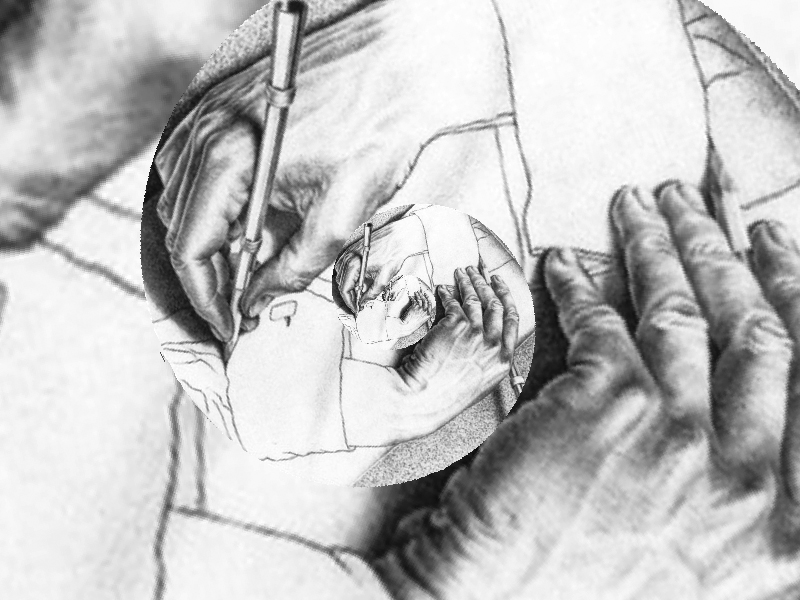
You get filmmakers like Tim Burton, who, lets face it, are BORING. Oooo a new Tim Burton film, I wonder how much gothic inspiration is going to be swirling around Johnny Depp’s strange character who doesn’t fit into society for whatever reason. He is the Iron Maiden of the film industry, releasing the same thing again and again and again in a never ending spiral that even M.C. Escher couldn’t comprehend (high brow art joke fnar fnar fnar).

If Escher gets confused, you know we're in trouble.

So with this film, you have all the general Almodóvar traits: strong female characters, pushing the boundaries of gender stereotypes, bright colours, obsession and the connections between people. Yet these are all just part of a much grander plot that becomes an incredible feat of genre mashing that keeps you on your toes. Jumping between thriller, mystery, family drama, body horror, suspense, revenge and psychosexual drama with an episodic, almost choppy narrative is definitely an experiment that could have gone horribly wrong, but we are safely in the hands of a master as he navigates us through this utterly batshit insane plot.

Antonio Banderas is our protagonist, a brilliant plastic surgeon who has holed himself away in his country home working on a single project for the last 6 years. He has created a skin that you can graft onto a human that is tougher than skin is supposed to be. His test subject has remained imprisoned in captivity and is the key to his past. That’s all I’m going to say because you really have to see it to believe it.

The cast is amazing, Banderas is suitably intense and brooding, Elena Anaya is the brilliantly fragile, yet menacing Vera and Almodóvar regular Marisa Paredes plays a brilliant matriarch. There is very little I can fault with this film, apart from maybe the pacing is a little slow through the middle. But that doesn’t really matter considering that every frame of film is full to bursting of visual imagery that will make your eyes bleed in ecstasy.

EVEN STATUES OF LIONS EYES' WILL BLEEEEEEEED

This film is an absolute must watch not only for its fantastic direction, or the great performances, or the insane plot, or the beautiful visuals, but because it’s fresh, new. I have never quite seen anything like it and leaving the cinema the only word I could really think of to describe it was AWESOME. What is so great about it is that it has more ideas rammed into it than the karma sutra. A film that is so very much the way I like my men….RICH.*

Would you have sex with a cartoon character if they were rich? I'm considering it...


*Author is aware that this is a terrible joke that you would expect from Sex and the City, or the back of a penguin wrapper.

Tuesday, 30 August 2011

SHIT

OH SHIT

IT'S BEEN A LONG TIME SINCE I'VE ACTUALLY DONE ANYTHING

MY BLOG FAILS

BUT NOT FOR MUCH LONGER
(hopefully)

You see, the problem with keeping a blog is that it has to be a habit. And I don't have an addictive personality, and therefore take a long time to pick up habits...the ones that I do have took me years and years to cultivate, such as my habit of eating chocolate...or that massive rock of crack I keep under my bed.

BUT FEAR NOT. I shall hopefully post something soon, maybe, once my life gets a little more sorted. THERE HAS BEEN SOME BUSY BUSY SHIT GOING ON.

I don't even know why I'm writing this, it's not like anyone is actually going to read this right? I should probably become popular before I write stupid ramblings and get on to writing something pointful and meaningful.

Or maybe I should just get really drunk and write a post...

Tuesday, 17 May 2011

13 ASSASSINS


Yes, well done it has the word ASS in the title...twice!

Rumour has it that if Takashi Miike’s production output falls below 4 feature length films a year the world will end and the gates of hell will open up, unleashing a deluge of demons so great that not even Jean Claude Van Damme will be able to stop them. This may have something to do with why in the last 20 years he has directed more than 80 films. And he doesn’t make just terrible film after terrible film either, he has been responsible for some of the classics of Japanese cinema, notably Ichi The Killer and Audition, which became cult classics in the western hemisphere. 13 Assassins definitely doesn’t show that the movie-making machine is slowing up either, remaining as intense and intelligent as the large part of his back catalogue.

The film follows the story of a Samurai, hired to kill an evil overlord looking to spread chaos and bring Japan back to an age of war. This of course is no easy task, and so he must recruit a band of loyal warriors prepared to give their lives in honourable combat to assassinate this crazy bad man.

If only it was real life...and the evil bad man was Jordan. Life would be good then.

So it’s very much a film that “does what it says on the tin.” At just over 2 hours long it is clearly split into 2 halves, the build up and the combat. And when I say halves, I literally mean it - the combat scene is the entire second half of the film. Now some would say that a whole hour of nothing but combat would begin to loose the intensity after a while, but it really doesn’t let up, it just keeps getting better and better.

Very much like an orgasm then...except with more violence. Well...depends on what kind of orgasm...

So where does the intelligence come in? Well apart from feeling very reminiscent of Akira Kurosawa’s masterpiece, Seven Samurai, it actually turns the genre on its head by playing out very much like many Hollywood films. A build up to a great stand off battle at the end, followed swiftly by a one on one show down between each gang’s leaders. It certainly feels like a film influenced by Hollywood and this could have been a let down, there are certainly some clichéd moments in it. But Miike has managed to keep enough Eastern energy in it for it to set itself apart from the usual generic crap. It is this delicate balance that keeps this film on your toes throughout where you think you know what will happen, but it never quite plays out that way.

Not only that, but there is an absolutely insane screwball character thrown into the mix. A wandering man who had been thrown out of his gang, looking to join in the fight for what appears to be a bit of a laugh and eventually leads to an incredible “wait….what the fuck?” kind of moment towards the films conclusion. He isn’t a samurai, but he’s quite keen to mock them and show them up whenever he can (he takes the phrase “bringing a knife to a gun fight” back to the Feudal Japanese era, using a sling and rocks against an army of swords and bows), even uttering the line “you samurai, you’re quite boring aren’t you?”.

 I don't think he'll be on the Christmas card list then?

So the film, being a bit of a mash up between East and West, manages to turn a rather generic and average samurai story into a film that is epic from start to finish. You can feel the burning sensation throughout the whole of the build up, which culminates in the explosive ambush (literally) and the intense, relentless battle that pushes your senses to a new place, with just enough comic humour to ease up the tension so you don’t feel like your bowels are about to explode after being squeezed too tight by muscular tension.

Let’s hope the next 80 films continue to be as fresh and original as their predecessors. And for God’s sake someone try to find a way to make someone live forever, because if Takashi Miike dies, the natural order of the world will fuck up in a way that makes 2012 look like your little sister’s tea party.

Or something as adorable as this.

Monday, 9 May 2011

THE EXTRAORDINARY ADVENTURES OF ADÉLE BLANC-SEC


Indianna Jones' really hot French grandma comes to town...

The problem with this age of information we live in is that before you actually go and see a film, you know more about it than the actual filmmakers (but then again, most big budget films have been assembled by a team of mentally challenged monkeys in a terrible bid to save money so the studios can computer enhance the size of Kiera Knightly’s tits). You’ve seen about 30 trailers, read interviews, seen the stars appear on chat shows, read reviews etc. etc. and the general publicity drive is something akin to the way Britney Spears is still trying to convince the world she’s a pop star.

"And after I release my new record, my new range of tampons will be hitting shelves!"

This is why I was glad to see this film without knowing a single thing about it, apart from the fact it was directed by Luc Besson - a man who gave us such fine action films as Léon and Nikita, as well as the hilariously terrible but completely unmissable The Fifth Element. So I figured I didn’t have much to lose as even if it was terrible, it was bound to get a good laugh along the way.

What I got was actually something completely unexpected. With a story that’s quite possibly the most batshit insane story for an adventure film, it makes Indianna Jones look like he was just raiding through that wardrobe in your parent’s bedroom you aren’t allowed to go near at Christmas time. It’s 1912 in France, and a renowned telepathic scientist has found a way to bring to life and control ancient beings, hatching a 130 million year old pterodactyl egg and flying it around the city. Adéle seeks the help of this scientist to bring to life an Egyptian pharaoh’s physician in order to revive her sister, who due to a freak accident has been turned into a breathing vegetable.

So this film seems like a bit of a mash up between Indianna Jones, The Mummy, but of course, this is French cinema, not some cheap Hollywood knock off piece of monkey faeces. It actually has a great sense of humour and will get you laughing at the sheer absurdity of the way it plays out whilst howling through the excitement of a great action film. Of course, being a French production there is nowhere near the sort of budget the Yanks get, but the average CGI only serves to add to the charm of the picture.

No Wolverine, bad CGI isn't THAT bad unless it's meant to distract you from a terrible story...

Charm: this film has it in buckets. It’s as though Luc Besson is sitting next to you, whispering sweet nothings in your ear to distract you from the fact that he’s about to slip a giant dose of LSD into your drink because the film certainly felt like one massive trip, constantly pulling some sort of ‘what the fuck?’ face whilst giggling like a psychotic child at the bizarre capers of bungling cops and the dark one liners Adéle constantly blasts whoever happens to be near her.

So what this film actually is, is FUN! Which seems to be a bit of a rarity nowadays. Not fun in the sense that you go and enjoy a film, but fun in the same way that your 8th birthday was, except there isn’t any cake involved.

I'm sorry, but you literally cannot mention cake on the internet now without this cropping up...

And this is what seems to be missing from the cinematic landscape as of late. We are in one of the worst economic situations in a long time, and all of the latest releases seem to be deadly serious and grounded in reality. Even the comedies are saccharine sweet with the big emotional kick. Very few films actually just take the plunge and go for an all out adventure that can just really lighten your mood. Besson has really done a fantastic job with this, making an unpredictable, charming, and all round bizarre film in what is set to be a series (the set up for the next potential film is fantastic). I really hope they make another one because it’s indispensable adventures like these that truly showcase the power of cinema in it’s ability to make you temporarily feel like you’re 8 years old again, which to be honest, us depressed and stressed out adults need every now and again.

This kid may be angry, but he really isn't giving a shit about it...

Friday, 15 April 2011

SOURCE CODE


Tasty…but not quite orgasmic.

Science Fiction as a genre regularly calls into question various thoughts and philosophies on mankind and our existence/place in the universe. 2001: A Space Odyssey called into question the relationship between violence and evolution, Blade Runner looks at the essence of life and identity itself and Alien is a superb allegory about the fears of sex and STIs (the constant imagery of penetration and egg laying resulting in death).

"It started out with a kiss, how did it end up like this?"
-as in that popular song by The Killers

So where does Source Code, directed by Duncan Jones - who directed the wonderful and stupidly low budget British sci-fi flick Moon - fit into the delicious space pie that is Science Fiction? The answer is, it doesn’t. The reason: it is an action thriller with a sci-fi backdrop, very much in line with films like Battle: Los Angeles (I swear to God they must have thought that making it really loud all the time would distract from the fact it’s just a 2 hour advert for the US Marines). What I mean is that the film adheres to the rules of the action thriller, but has various sci-fi elements to it, lacking that real interrogation of human nature. Example: Battle: Los Angeles is an action/war film, except with aliens instead of people.

Colter Stevens (Jake Gyllenhaal) is a soldier trapped in another man’s body (a man by the name of Steven Fentress), forced to re-live the last 8 minutes of that man’s life leading up to a bomb exploding on a train. This is made possible by what is called the Source Code - a secret military program. He does this because the bomber of the train has threatened another attack on the city of Chicago and the authorities need to identify him before he can carry out this plan. Each time Colter fails to identify the bomber and the bomb goes off, he is thrown back into reality before being thrown back to the beginning of the 8 minutes again.

A sort of Groundhog Day scenario.

I'm sorry Bill, magic rodents just don't cut it anymore...

This kind of premise is definitely the sort of direction you would expect Duncan Jones to go in, and he has done very well with the script he has been given. You can definitely see the flair of intrigue and examination that made Moon such a great film. The only problem with it is that the action thriller part of it drives the story too fast to truly explore the implications of alternate realities and the effect of death on the human psyche (Colter dies at least 7 times).

So when he begins his investigation, every time interrogating a different person, everyone is a suspect. Very much a standard find the bomb and piece the clues together to find the terrorist and stop the bomb setup that is screaming for Jack Bauer to jump in and torture everyone before fucking everything up and killing everyone whilst somehow managing to save the day. But there’s one more piece of Hollywood tripe that drags down these interesting, high concept ideas. A woman.

Megan Fox is essentially a plot device in every film...she's just terrible.

Ah yes, the woman. The female of the species. The plot device for writers who need to stretch an action film to fill the average 90 minute running time for a film. Again, however, this could have been an interesting idea to toy with, as she essentially falls for Colter’s personality even though he is not in his own body. A serious WTF!? kind of situation. But no, ignore that, instead he has to save a woman he falls in love with after knowing her for a total of about 45 minutes…

No internet blog is complete without a picture of a cat...

This film has Hollywood’s greasy, fat, money grabbing hands all over it and is throwing in all of the usual action thriller tropes to take concepts down to the lowest common denominator in order to sell it to people who read The Sun and watch The X Factor. They are still assuming the audience are a bunch of idiots.

There is however, a glimmer of hope in all of this. Duncan Jones has done superbly well with the script he has been given to make a thoroughly enjoyable action thriller that raises enough questions from the sci-fi side of things to get the old brainbox thinking. Adding to the slowly growing trend of action films that actually make you think (do I really have to mention Inception?). Audiences are getting tired of the same old shit and want something with a bit of a brain to it.

So, 2 films in and Duncan Jones has a pretty impressive track record. The outstandingly observant and interesting Moon followed by the pulse pounding action thriller Source Code…all we need now is for him to mix the two together with his next film and he very well could be making the next Blade Runner - a great action film with a great big juicy philosophical sci-fi brain behind it.

Mmm...tasty philosophy...

Friday, 8 April 2011

SUBMARINE


As a teenager, we all secretly wish we were French.

The relationship between Britain and France is largely based on stereotypes. The French - wearing berets and onion/garlic necklaces whilst smoking and looking like a pretentious dick, and the British - drunken football fanatics who like to glass you in the face or charming Hugh Grant types who like to get glassed in the face. Either way, there has always been an underlying PLAYFUL (not racist) hatred.

Much like these guys really.

However, there are qualities from each nationality that are endearing. The French provide that certain ‘je ne c’est quoi’ that makes the films they make impossibly chic and stylish and the British are masters of awkward comedy and social drama, where you end up giggling like a school girl whilst writhing in your seat in embarrassment - as though your parents have just walked in on you masturbating - followed by a brief cry at the social injustices that befall the characters. It’s these two qualities that are merged together by Submarine that make it very different from the average British film.

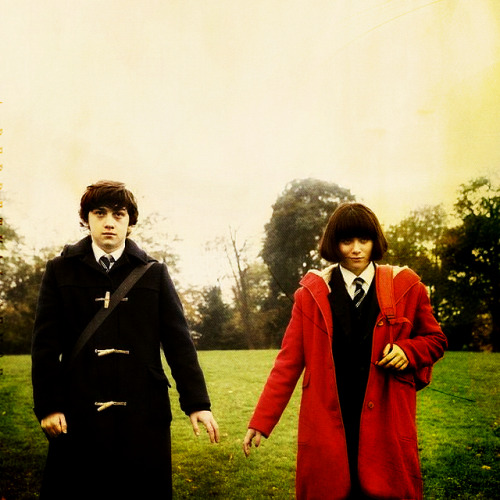
Oliver Tate is coming of age and trying to find out who he is. Yet more importantly, he’s trying to get his leg over. Enter Jordana, a girl who is completely alien and yet so familiar. Throw into the mix the fact that he’s trying to save his parents marriage as well and you’ve got a pretty standard set up for a very British film.

But here is where the film cracks out the snails and dons the beret. The film itself is very French in the way it has been constructed. The playfulness of the French New Wave is infused in every sequence, yet the films director, Richard Ayoade (better known as Moss from TV’s The IT Crowd), owns the style in a more controlled manner as to avoid the anti-narrative tangents that the 60s film movement often divulged into. Montages of romance are interspliced with awkward family conversations and ridiculous slapstick, teenage humour with some rather disjointed interactions that can so easily cause a film to become thinly spread and schizophrenic - thankfully, this is not the case.

This is what could have happened...

This technique of filming is intrinsically linked to the fact the story is entirely told from Oliver’s point of view. Based on a novel that speaks entirely in the first person, the films construct becomes the visual representation of the internal thoughts he has. A line of voiceover (a regular occurrence in the film) sums it all up - “I often wish there was a film crew following my every move. Someone making a documentary about a prominent thinker who struggled with unspeakable loss.” The visual style of the film is how he imagines this documentary would be, and this calls into question just how British Oliver really is. If he is British, why does the film as told from his perspective remind me so much of the French New Wave?

This brings me back to the opening statement about teenagers wanting to be French. The most relatable part of the film, what makes it so charming, is the sheer pretentious arrogance that possesses Oliver. It is an arrogance that we have all embraced at some point in our lives around his tender age of 15. We’ve gone through phases, we’ve tried to be like our role models, we’ve tried to get laid, ALL of us have at one point, been like Oliver in our own way.

Of course I am now implying that the French are pretentious and arrogant. Of course I don’t mean that. For one thing, it helps them have a certain look like this...

"Ooh la la"

...and the image we Brits get across is something like this...

"Hang on Dave, I'll take you to hospital in a minute. I FOUND FLOOR CHIPS!"

So is this film’s rich blend of French and British (what I like to call Fritish) a mere mark of the stereotypical view we have of the French? Or is it just a heavily influenced film that has given a breath of Fresh air to the usual British film? Who cares? It’s a real gem of a film and not to be missed.

Which leads me to another point. Recently, we are seeing British directors coming into their own to make new and innovative films that better the latest Hollywood bank breaking projects. Duncan Jones with Moon, Edgar Wright with Shaun of the Dead, Gareth Edwards with Monsters and one I’m particularly excited about seeing, Joe Cornish with Attack The Block (Released May 13th). All of which have a hand in making some of the newer Hollywood films. We are seeing an uprising of British directors looking to take Hollywood by storm, to turn their tired and formulaic paint by numbers filmmaking into something new and great, to breathe life into a lagging film industry struggling with recession and piracy. I for one, am very excited for what could come around in the next few years.

As the French might say - “Vive la Révolution!”